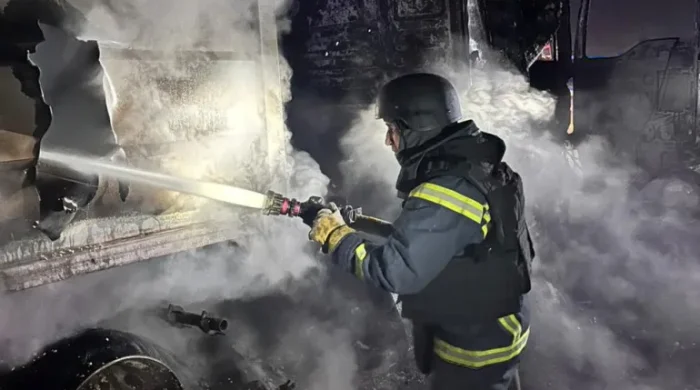
A Russian ballistic missile strike on port infrastructure in Ukraine’s Odesa port in the south has killed at least eight people and wounded 27, as Moscow intensifies attacks on the strategic Black Sea region and talks to end the war remain in a critical stage.
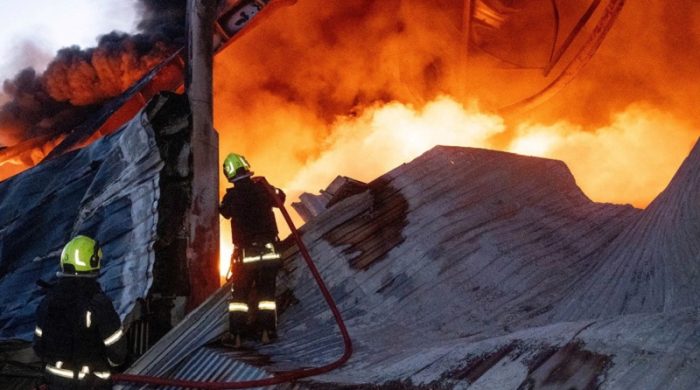
The attack late on Friday hit critical logistics infrastructure, with some of the wounded trapped on a bus at the strike’s epicentre as trucks caught fire in a car park.
Ukrainian officials say the bombardment is part of a sustained Russian campaign against Odesa’s civilian infrastructure that has left more than two million people without electricity, water and heating for days amid freezing temperatures in the war’s fourth punishing winter.
Moscow struck the same port again on Saturday, hitting reservoirs in what Ukrainian Deputy Prime Minister Oleksii Kuleba described as deliberately targeting civilian logistics routes.
The escalation comes as both sides trade blows across multiple fronts, while United States-led negotiations and numerous high-level meetings in Europe to end the war lumber on without a breakthrough.
Russia claimed on Saturday to have seized the villages of Svitle in the eastern Donetsk region and Vysoke in the northeastern Sumy region, though the reports could not be independently verified.
Ukraine has responded with a widening campaign against Russian military and energy assets.
On Friday night, Ukrainian drones struck the Filanovsky oil rig belonging to Russian energy giant Lukoil in the Caspian Sea, along with a military patrol ship patrolling near the platform.
Advertisement
The attack marked the first officially acknowledged Ukrainian strike on Caspian drilling infrastructure, though the rig had been hit at least twice before in December.
Between December 14 and 15, Ukrainian forces used sea drones to strike a Russian Kilo-class submarine at the Novorossiysk Naval Base in the Black Sea, according to a United Kingdom Defence Intelligence assessment.
Miami talks
The attacks unfold as American and European officials gather in Miami for weekend talks aimed at ending the nearly four-year war, with Russian and Ukrainian teams also in attendance.
Russian envoy Kirill Dmitriev said on Saturday he was heading to Miami.
US Secretary of State Marco Rubio said Washington would not force Ukraine into any agreement, though he described the conflict as “not our war”.
Trump envoys Steve Witkoff and Jared Kushner are leading discussions with Ukrainian negotiator Rustem Umerov and officials from the UK, France and Germany. Russian representatives, including Kremlin key negotiator Dmitriev, are meeting separately with American officials.
The key obstacle remains territorial concessions, with reports suggesting Washington is pushing Kyiv to cede parts of the eastern Donetsk region.
Russian President Vladimir Putin showed no signs of compromise at his annual choreographed news conference on Friday, pledging to press ahead with military operations and predicting new successes before the year’s end.
Putin’s remarks were the latest in a drumbeat of often-repeated maximalist Russian positions nearly four years after he ordered troops into the neighbouring country.
The issue of territory gained, lost, to be ceded or not, delves into the heart of the matter on one of the most contentious issues in the talks to end the war so far.
Putin has demanded Ukraine cede all territory in four key regions his forces have captured and occupied, along with Crimea, which Moscow seized and annexed in 2014.
He also wants Ukrainian troops to withdraw from parts of eastern Ukraine that Russian forces have not yet taken in the eastern Donetsk region, where fighting remains attritional – conditions Kyiv has rejected outright.
As talks continue, so does the fighting, with Russia controlling large parts of Ukraine’s eastern and Black Sea coastal regions.
Putin projected confidence on Friday about battlefield progress, saying Russian forces had “fully seized strategic initiative” and would make further gains before the year ends.
However, that narrative is on shaky ground this week, as Moscow’s assertion of inevitable victory flew in the face of facts on the ground.
Ukraine steadily took back control of almost all of its northern city of Kupiansk after isolating Russian forces within it, belying Russian claims to have seized it.
Russian forces were also unable to dislodge Ukrainian defenders from the eastern city of Pokrovsk in the eastern area of Donetsk to back up Moscow’s claims of total control.
Ukraine received a boost on Friday when European leaders agreed to provide a 90 billion euros ($105bn) loan to cover military and economic needs for the next two years.
President Volodymyr Zelenskyy, who met Polish President Karol Nawrocki in Warsaw the same day to reinforce regional unity against Russia, said the funds would go towards defence if the war continues or reconstruction if peace is achieved.