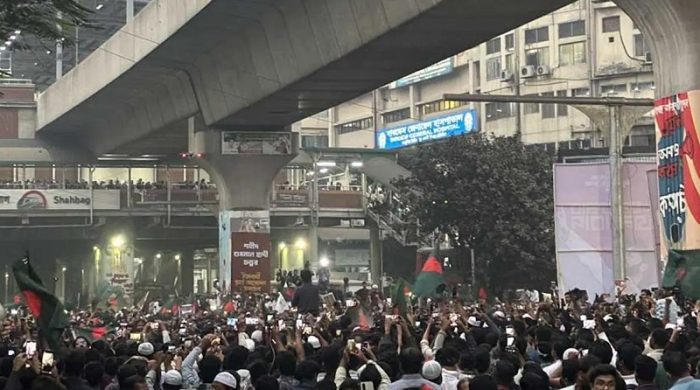
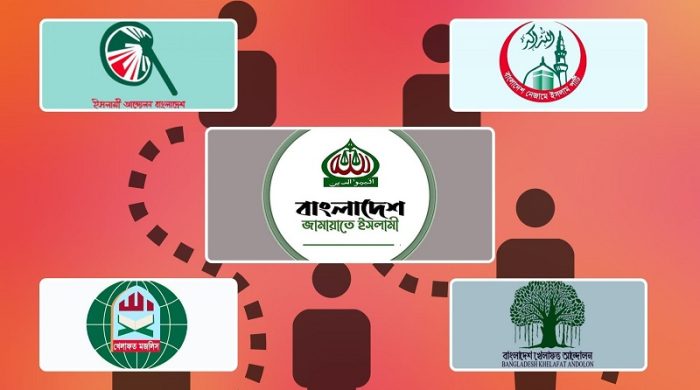
Discussions are underway regarding seat adjustment among Jamaat and eight Islamic parties for the 13th parliamentary election. Although they have announced that candidates will be selected through mutual understanding, the parties that have come together on one platform are facing major challenges. Jamaat, in particular, is under pressure to meet the demands of smaller parties. According to internal sources, although disagreements have not surfaced publicly, it is almost certain that seat distribution based on consensus will not be smooth. Informal sources say Jamaat will contest elections in 200 seats under the eight-party understanding. The Charmonai-based party will contest 50 seats, Khilafat 15 seats, Khilafat Majlish 15 seats, Nezam-e-Islami eight seats, and Khilafat Andolon eight seats.
Jamaat Wants More New Parties on Its Side:
Through a unified programme based on five-point demands, Jamaat has shaped its electoral strategy by maintaining pressure on the government along with seven like-minded parties, including Islami Andolon. At the same time, constituency-based surveys are being conducted following the principle of “one candidate in one seat.” Candidates will be finalised based on the survey results. According to relevant sources, efforts are underway to bring a few more parties into this potential electoral understanding.
Jamaat and the eight parties are moving toward finalising seat adjustment by referring to it as an “electoral understanding” rather than forming an alliance. Leaders of the parties believe this may be finalised by December. A central Jamaat leader, speaking to the media on condition of anonymity, said more parties may join the eight like-minded parties and surprises may emerge in the seat adjustment process.
Jamaat Ameer Dr Shafiqur Rahman told journalists, “We will not form any conventional alliance. But we will have electoral understanding with many parties and forces.”
Giving Up Seats Based on Popularity:
Sources related to Jamaat and the eight like-minded parties say decisions on nominations or giving up seats will not be based solely on political agreements. Instead, the popularity of candidates of different parties in specific constituencies will be verified at the field level before final decisions are taken.
Decision to Contest Under Own Party Symbols:
The eight parties agreed on joint movements. Alongside discussions with the Consensus Commission on reform initiatives, they took to the streets with five-point demands. During this time, talks continued on forming an electoral alliance. However, due to ideological differences between Jamaat and Qawmi-oriented parties, the idea of an alliance was dropped and the parties moved forward with a plan of understanding instead. It was decided in principle that no alliance leader would be appointed and that all parties would contest under their own symbols. According to the understanding, there will be only one candidate from one party in a constituency, and the other parties will extend full support to ensure that candidate’s victory.
Parties Want to Move Forward With ‘One-Box Policy’:
All parties will sit together to reach an understanding on seat sharing. Jamaat is aware of the demands of each party. The core objective is the ‘one-box policy’, meaning all Islamic party votes will be cast in one box. Eight-party nominated candidate and liaison committee coordinator Dr Hamidur Rahman Azad told the media that the activities of the eight parties are not an electoral alliance, but a movement-based platform. He said, “We are working on the ‘one-box policy’. That means there will be one candidate nominated by the eight parties in one constituency, decided through mutual understanding. Where there is one candidate on behalf of the eight parties, no other party from the eight will field a candidate there.”
He added, “We will all make maximum efforts together to achieve victory. That is our goal. We will complete the candidate selection process as quickly as possible, InshaAllah.” In response to a question, he said they would hold discussions separately with each party first and then reach a final understanding through talks with all parties together.